
What a Lucky Jet strategy can actually control
A useful Lucky Jet strategy sets the stake, the cashout instruction and the point at which you stop. It does not tell you the next crash point. Fixed stakes make spending easier to track; an automatic cashout, where the client offers one, reduces the number of decisions during a round. Neither creates a mathematical advantage. If the aim is to avoid gambling losses altogether, the appropriate stake is zero. The worked plan below is for understanding exposure, rather than a recommendation to play or a forecast of profit.
This page answers the strategy question. The existing beginner guide covers the interface and first-session workflow. We have not verified a current, first-party Lucky Jet payout specification or audited a live client for this article. In particular, the 97% return used below is a chosen teaching assumption, not a confirmed Lucky Jet RTP. Check the rules attached to your exact game before applying any calculation. A missing specification is an unknown input, not permission to borrow a number from a review site.
Write the limits before opening a round
Use an example budget of 100 units, a fixed stake of one unit and a maximum of 50 settled bets. Stop earlier if the balance reaches 90 or 110 units. These are illustrative limits, not an optimal allocation of anyone's money. The entire 100-unit budget must already be affordable to lose. A ten-unit stop is a plan for ending play, not a guarantee against a larger operational loss caused by extra bets, disputed settlements or instructions that were not accepted.
Record all four limits together. A time limit can be added, but it must shorten the plan rather than extend the bet limit. Do not deposit again, open another account or start a second session immediately to undo a stop. Otherwise the nominal boundary has merely split one longer session into several labels. If the minimum permitted stake is too large relative to the chosen budget, there is no suitable small-stake implementation of this example. Passing on the session is a valid outcome.
Fixed stake means no loss recovery ladder
At a one-unit fixed stake, five failed bets cost five units. A doubling progression stakes 1, 2, 4, 8 and 16 units, consuming 31 units over the same five failures. The chance of a later success does not repay money automatically; it depends on the payout and the next stake actually being accepted. A progression also collides with balance limits and maximum stakes. The loss-recovery story usually hides those conditions while displaying only the sequence that eventually wins.
For the same reason, do not increase the unit after a profitable start. That changes the plan precisely when the account balance is most emotionally salient. Fixed means the same amount for every accepted bet, including bets after a loss or a win. An unaccepted instruction is not a wager and belongs in an execution note, not the settled-bet count. Two simultaneous bets also count as two exposures. Splitting one intended stake between two buttons does not make either part free.
The model behind the target comparison
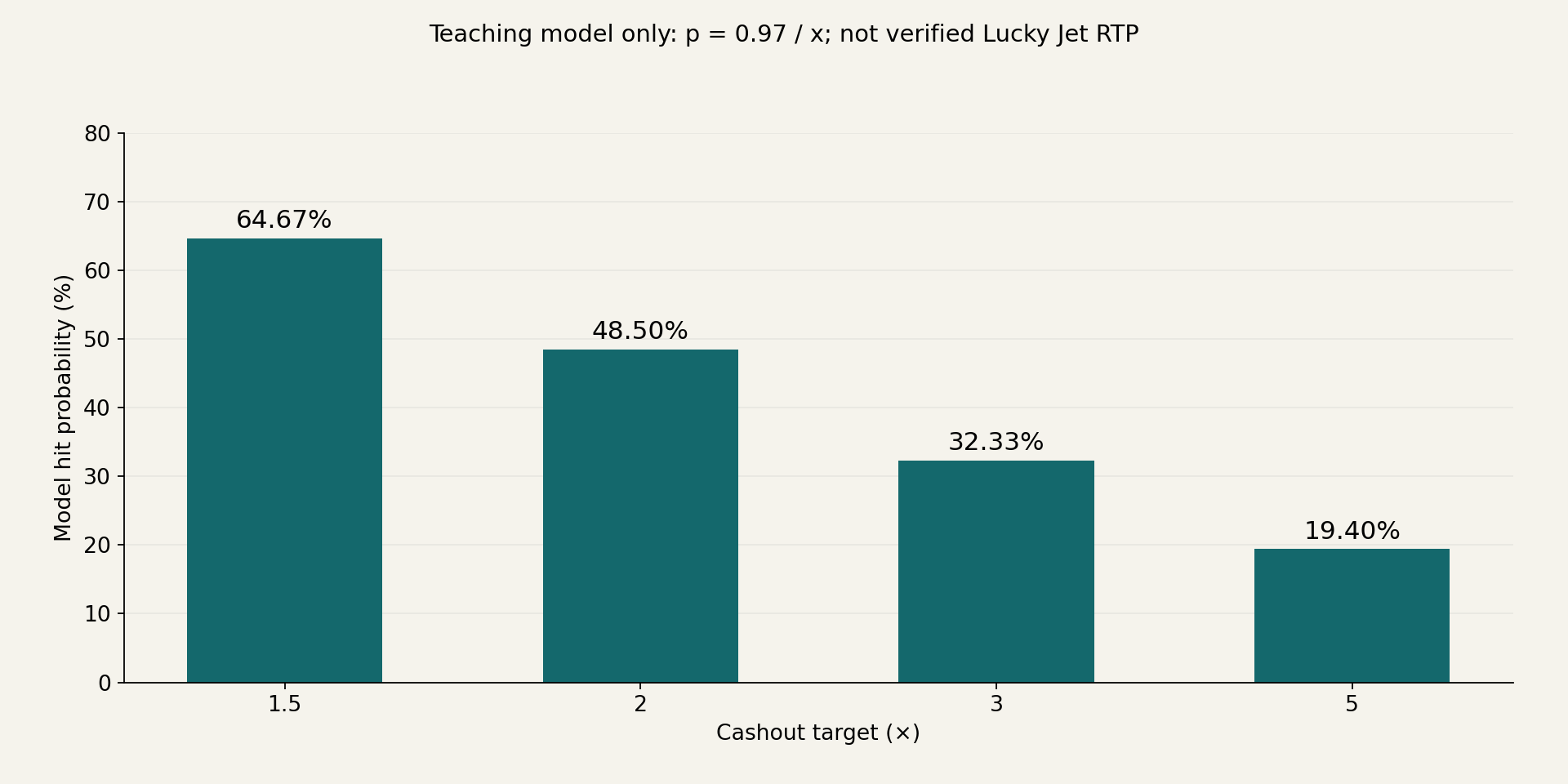
For this teaching model only, let the chance of reaching target x be p = 0.97 / x. Each round is independent, a failed bet loses its whole stake, and a successful cashout returns x times the stake, including the original stake. The model excludes rounding, caps, interrupted rounds, fees and payout disputes. Those exclusions matter when comparing it with an actual product. We are defining a mathematical distribution here, not estimating a probability from recent Lucky Jet rounds.
Expected net result per unit staked is p × (x − 1) − (1 − p), which simplifies to p × x − 1 = −0.03. At 2×, a one-unit successful bet earns one net unit, not two. At 1.5× it earns half a unit. Keep gross return and net profit in separate columns; mixing them makes a strategy appear profitable even when its arithmetic says otherwise. The accompanying table and chart use exactly these assumptions and no collected round history.
| Target | Model hit probability | Expected loss / 100 wagered |
|---|---|---|
| 1.5× | 64.67% | 3.00 |
| 2.0× | 48.50% | 3.00 |
| 3.0× | 32.33% | 3.00 |
| 5.0× | 19.40% | 3.00 |
Why a lower cashout is not a higher return
In the model, 1.5× succeeds more often than 3×, but each success earns less. The expected loss remains three units per 100 units wagered at either target. A high hit rate can therefore coexist with a negative expected result. It is especially easy to miss this when a session contains several small wins followed by one loss that absorbs them. Counting green outcomes without weighting their monetary size cannot measure profitability.
The target changes variability as well as the appearance of the history display. The net variance per one-unit bet is 0.97 × x − 0.97² under this distribution, so larger targets produce more dispersion. That is a statement about the model, not a calibrated Lucky Jet risk score. A target choice must also fit the client's supported range and settlement rules. There is no universally best cashout number established by the examples on this page.
Automatic cashout is an execution setting
If automatic cashout is available, read how the client accepts the setting, whether it persists between rounds and what happens after a disconnection. Confirm the displayed stake and target before a bet is accepted. Availability and rules can differ by client or jurisdiction. We have not tested a live Lucky Jet implementation, and an automatic setting should not be described as a guaranteed settlement service. It reduces reliance on a timely manual click only to the extent the documented implementation does so.
An illustrative missed-cashout calculation shows why execution matters without claiming a measured failure rate. If 1% of otherwise successful model bets instead lose the whole stake, independently of the outcome, effective gross return becomes 0.97 × 0.99 = 0.9603. Expected loss rises to 3.97% of turnover. The 1% is an invented scenario input. Real failures may have different settlement treatment and dependence, so do not use this number as an estimate of network latency or any operator's performance.
What the session boundaries change
The calculation appendix follows the 100-unit starting balance at a 2× target, with one-unit stakes, up to 50 bets and absorbing boundaries at 90 and 110. It adds the probability of each possible next balance rather than generating a lucky simulation run. All paths stop at the same stated rules. The appendix reports expected bets, expected ending balance and the probability of reaching each boundary. The probabilities are model outputs, not observed player outcomes.
Stopping early reduces expected turnover in this finite example. It does not change the three-percent expected loss on each unit actually wagered. The check is expected ending balance = 100 − 0.03 × expected number of bets. A profit stop can lock in a particular path's positive result, while other paths end below the starting balance. Showing only sessions that hit the upper boundary would discard the losing paths and give a misleading picture of the rule.
Keep a ledger that can answer a question
For each settled bet, record the stake, target, gross payout and net result. Keep rejected instructions, disconnections and unresolved bets in a separate status field. Reconcile the total with the account balance and exclude deposits and withdrawals from gambling returns. A balance increase after a deposit is not a win. Equally, an unresolved payout should not be treated as a confirmed zero or silently dropped from a rate calculation.
A ledger is useful for checking adherence to a spending plan and detecting discrepancies. It is not a predictor. A run of low multipliers gives no new information about the next independent round in this model. Changing the target because a large multiplier appears overdue introduces another decision rule without evidence of an advantage. If the recorded rules are repeatedly being overridden, the appropriate response is to stop the experiment, not to add a more complicated recovery system.
Read the evidence at the right level
Our internal beginner guide explains navigation; the bankroll framework explains session accounting. Neither supplies an independently verified current Lucky Jet payout law. The downloadable calculation file documents this article's inputs so another reader can reproduce the arithmetic. It contains no scraped rounds, player balances or claims of successful betting. The source limitation is part of the result: this is a bounded example of negative-expectation exposure, with product-specific probabilities still unverified.
The practical sequence is therefore short. Establish the exact game and rules, decide whether any exposure is affordable, write the stake and stopping conditions, and check every accepted instruction against them. End when any limit is reached. Do not turn the model's average into a promised session result or regard a winning sample as validation of a predictive system. A strategy can constrain your decisions; it cannot turn an unverified probability assumption into a fact.