
Four panels can still be one round
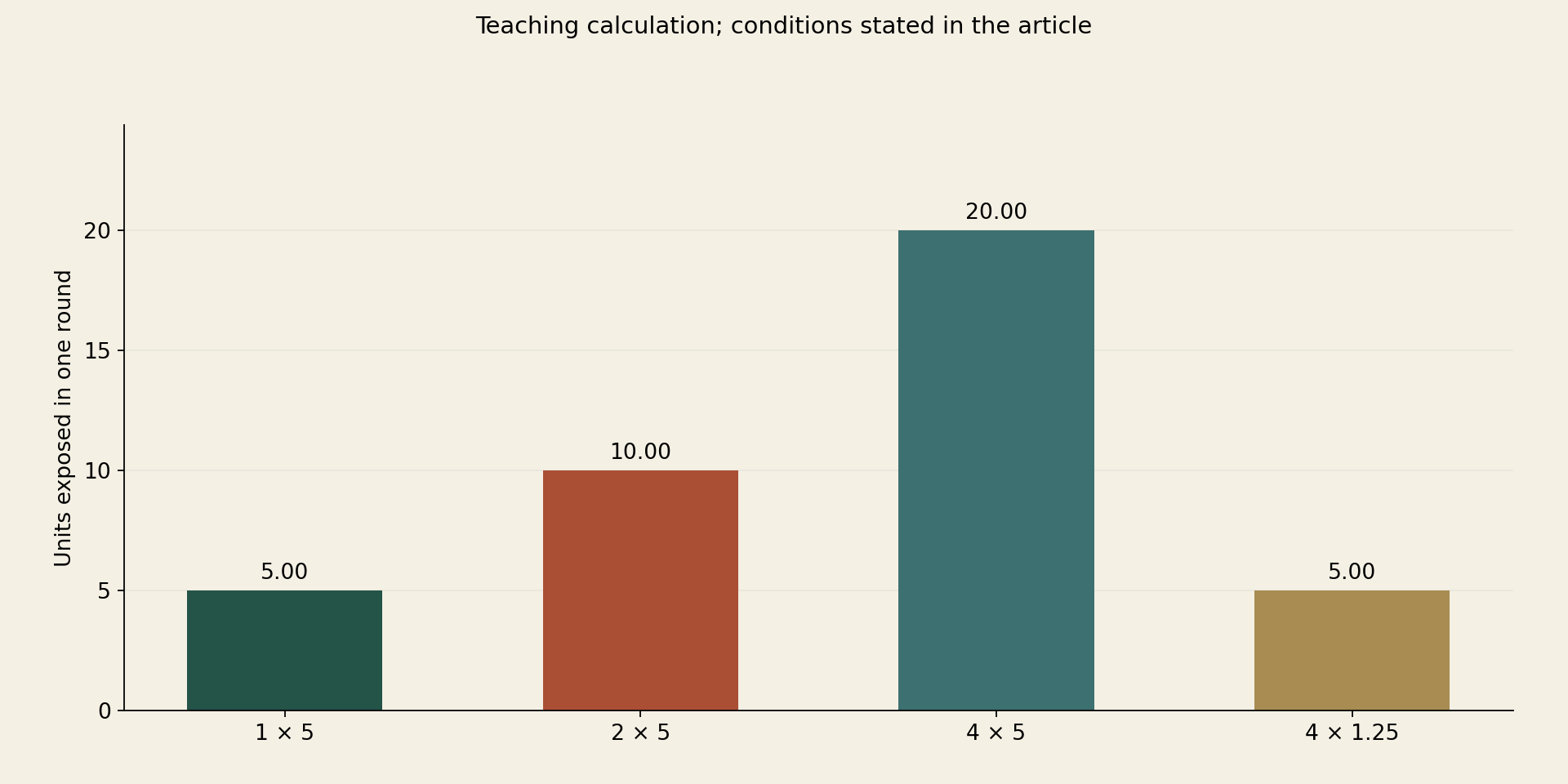
Four stakes of five units expose twenty units, even when each button looks small. That is the starting point for a useful JetX plan. Count the accepted stakes across the whole round before deciding whether the amount fits your budget. Several panels do not create several independent crash outcomes. They create several claims on the same round, potentially with different cashout instructions. A larger interface can therefore increase spending without changing the amount entered in any individual field.
This guide concerns the SmartSoft JetX demo rules loaded on 3 November 2026, version 2.2.0.0. We read the information without placing bets. The rules describe one, two or four stakes, automatic cashout and a conditional RTP range of 96.2%–98.9%. That is a description of the inspected demo, not a verified configuration at every operator. The arithmetic below is our own teaching example. It does not reconstruct the distribution of crash points or predict the next round.
Set a round budget before choosing the layout
Choose an amount for the entire round, then divide it between panels if you use more than one. With a five-unit round budget, four equal panels would contain 1.25 units each, subject to the client's minimum and permitted increments. Keeping five units in every panel instead multiplies the budget by four. This distinction is easy to miss when switching layouts because the interface can present each stake as a separate small decision.
| Panels | Stake per panel | Total at risk |
|---|---|---|
| 1 | 5.00 | 5.00 |
| 2 | 5.00 | 10.00 |
| 4 | 5.00 | 20.00 |
| 4 | 1.25 | 5.00 |
A round limit and a session limit answer different questions. The first caps exposure to one crash outcome. The second limits the cumulative activity you are willing to fund. Neither requires using the whole account balance. If the permitted minimum makes your chosen division impossible, reduce the number of panels or skip the round. Increasing the budget just to make the interface convenient defeats the purpose of setting it first. Do not treat funds reserved for everyday expenses as a session reserve.
Separate gross return from net result
A successful one-unit cashout at 2× returns two units in total, including the original stake. Net profit is one unit. Four one-unit bets cashing out at that same target produce eight units gross and four units net. If all four fail before settlement, the total loss is four. These are payout identities conditional on success or failure, not probabilities. Caps, rounding and settlement treatment must be checked separately before applying them to a real client.
Using the same target on every panel does not turn those four bets into a diversified portfolio. In a simplified threshold example with identical execution, either the shared round reaches the target or it does not. Splitting a four-unit stake into four one-unit stakes leaves the same total conditional payoff. Different targets change the payoff shape, but exposure still shares the underlying round. A genuine risk calculation would need the joint settlement rules and the game's actual outcome distribution, which we have not inferred here.
A low target is not a universal probability formula
The inspected rules give a range for RTP and connect the highest return with the lowest available cashout target. They do not publish a complete probability distribution in the material captured for this guide. We therefore do not assign every target a hit probability using p = 0.97 / x, or label every JetX client a fixed 97% game. A convenient formula from another crash article cannot supply missing product evidence.
Even an applicable theoretical RTP would be an average over the relevant wagering conditions, not a promised personal refund. A short session can end far above or below that average. Likewise, a screenshot of recent multipliers does not identify a stable statistical edge. The recent display shows completed outcomes. Without an independently established predictive relationship, it does not justify increasing stakes after a run of low results or chasing a large multiplier that seems overdue.
Automatic cashout and autoplay do different jobs
Automatic cashout specifies an exit condition for an accepted bet. Autoplay can initiate further bets. Read both settings separately, including which panel each applies to and whether it persists after a layout change. A checked exit setting does not mean subsequent wagering has stopped. Before starting any automated sequence, verify the total intended stake across panels and the conditions under which the sequence ends. Availability and restrictions can vary between versions and markets.
The rules inspected here also describe server processing and disconnection behaviour. We did not measure latency, test settlement failures or reproduce every branch in the client. An observed click is not evidence that a request has already been processed. Avoid describing either manual or automatic cashout as an unconditional guarantee. If the client presents a pending or unresolved state, record that state until settlement is confirmed rather than counting the amount as a completed win.
Why several targets do not insure the larger stake
Consider two one-unit panels, with an early target on one and a later target on the other. The early panel can succeed while the later one fails. Whether the combined round is positive depends on the first payout and both original stakes. For example, one successful cashout at 1.5× and one lost one-unit bet produce 1.5 gross against two staked, a net loss of 0.5. A visible success on one panel has not insured the full round.
Calling this arrangement a hedge can obscure the accounting. It may reduce or increase variability compared with a particular alternative, but no universal improvement follows from the number of panels. Compare total money at risk and the complete payoff in each scenario. Leave the probability column unknown unless a valid source or a clearly labelled mathematical model supplies it. Do not fill that column with percentages guessed from the interface or copied from a different game's rules.
End the session by a written rule
A finite example might allow twenty rounds with a total stake of one unit per round. If all twenty are completed, turnover is twenty units regardless of how each unit is divided. Using four one-unit panels instead generates eighty units of turnover over the same number of rounds. The number of rounds alone therefore cannot measure spending. Track the sum of accepted stakes and any extra exposure created by settings that continue placing bets.
Write the ending conditions before play: an affordable spending boundary, a maximum number of rounds and a time limit. Stop when the first applicable condition is reached. A profit target can end a favourable path, but it is not evidence of positive expectation. Restarting immediately to recover losses makes the apparent boundary a bookkeeping label. If you cannot keep the original amount fixed, the practical response is to stop rather than invent another recovery progression.
Keep a ledger that matches the client
Record round identifier, panel, accepted stake, intended target, gross settled payout and status. Add the stakes across panels before calculating a round's net result. Deposits and withdrawals are cash transfers, not payouts from the game. Separate rejected instructions and unresolved transactions from settled bets. This makes it possible to distinguish a spending error, a settlement discrepancy and a losing outcome without pretending that every balance movement has the same cause.
The ledger can also reveal an unintended change in exposure: a new layout, an extra active panel or autoplay continuing beyond the planned session. It cannot by itself prove the configured RTP or predict a future result. Our calculation file contains only deterministic examples and no collected rounds. Reproducing twenty units of exposure from four five-unit stakes verifies addition; it does not verify the product's random-number generation, commercial return or performance at a particular operator.
Check the version before copying a setup
The existing comparison page introduces several crash products; the Lucky Jet strategy page covers its own bounded example. This JetX guide does not make their mathematical assumptions interchangeable. Start with the exact title and rules, identify the total accepted stake, distinguish exit automation from repeated wagering and reconcile the final settlement. If the current client differs from the inspected demo, the client's documented rules need their own review. Keep the budget decision independent of how many controls the screen offers.